A walk of about two hours through the old walled town of Úbeda, a World Heritage Site, that you can do on foot straight from the house.
Download the route as a PDF (in Spanish)
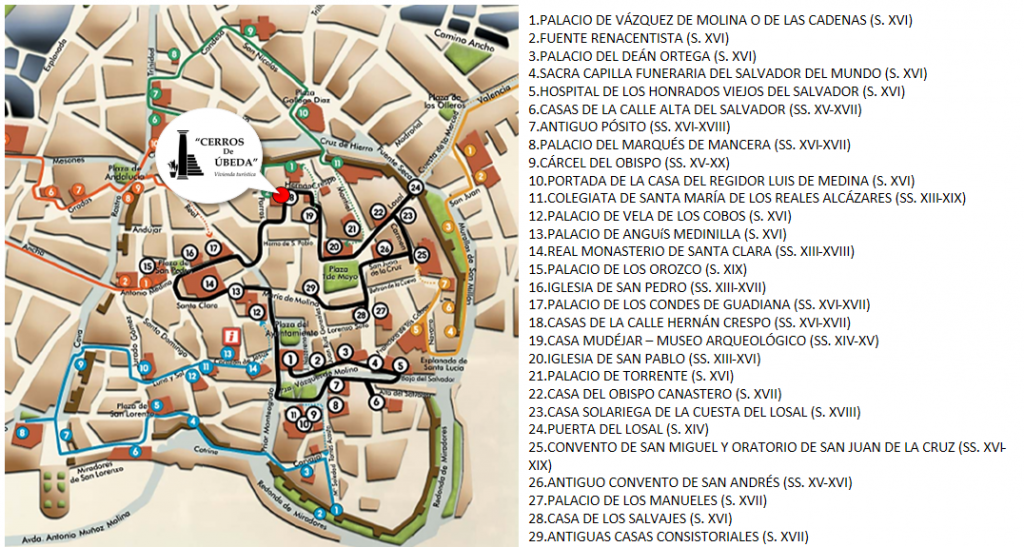
Plaza Vázquez de Molina
The route starts in one of the most beautiful squares in Europe and one of the finest examples of Renaissance town planning.
Palace of Juan Vázquez de Molina
Built by Andrés de Vandelvira around the mid-16th century, perhaps the most classical work of the whole Andalusian Renaissance. Look out for its symmetrical façade, with the architectural orders reversed and atlantes and caryatids on the third floor, and its columned courtyard.
Its basement houses the Andrés de Vandelvira Interpretation Centre.
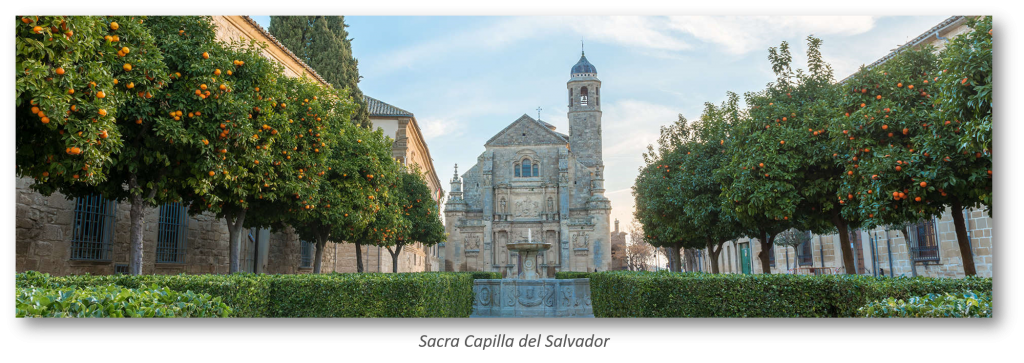
Sacra Capilla del Salvador
The great funerary chapel that Francisco de los Cobos, secretary to Emperor Charles V, had built in his home town. Designed by Diego de Siloé, its round apse follows the model of the Pantheon in Rome.
Its doorway, by Esteban Jamete, is one of the richest of the Spanish Renaissance. Inside are a magnificent screen and the altarpiece with Berruguete’s Transfiguration.
Other buildings on the square
The fountain given by the Venetian senate, the Palace of Dean Ortega, the Hospital de los Honrados Viejos and the Palace of the Marquis of Mancera, one of the noble houses with a tower.
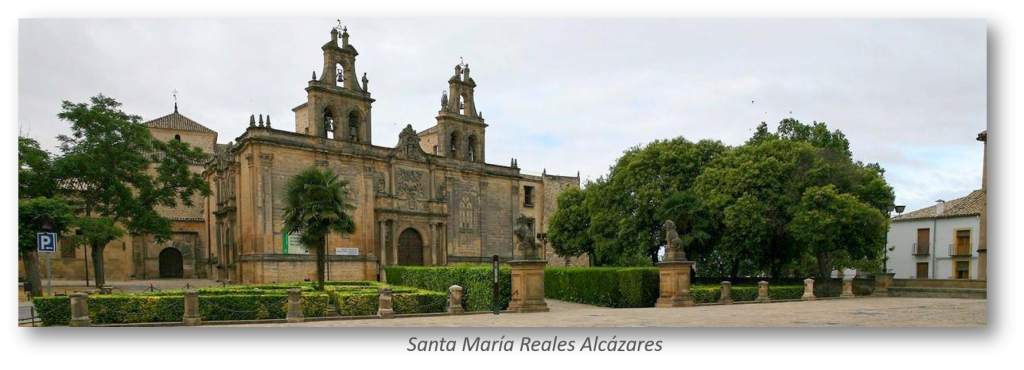
Santa María de los Reales Alcázares
The town’s main church closes the square. It stands on the site of the old great mosque and was built between the 13th and 19th centuries.
Its Gothic cloister and five naves, with superb iron screens, still recall the size of the mosque.
From the Town Hall to San Pedro
On Plaza del Ayuntamiento stands the Palace of Vela de los Cobos, by Vandelvira, with its characteristic corner balcony.
Nearby is the Royal Monastery of Santa Clara, from the 13th century, the best example of Gothic-Mudéjar architecture in the town. Next to it are the church of San Pedro and the Palace of the Counts of Guadiana, with one of the most beautiful towers in Spain.
From the Market to Saint John of the Cross
The Casa Mudéjar, from the 14th and 15th centuries, is now the Archaeological Museum. Next to it opens Plaza 1º de Mayo, the old Market Promenade, presided over by the church of San Pablo and Úbeda’s finest Renaissance fountain.
The town walls are almost entirely preserved. Their most monumental gate is the Mudéjar-style Puerta del Losal.
Close by is the Convent of San Miguel, where Saint John of the Cross died in 1591. Its oratory was the first church in the world dedicated to the saint and today houses a museum about the poet.
The route ends at the Old Town Hall of 1604, with its double arcaded gallery.
Fancy some nature?
Discover the hiking routes in the Sierra de Cazorla.